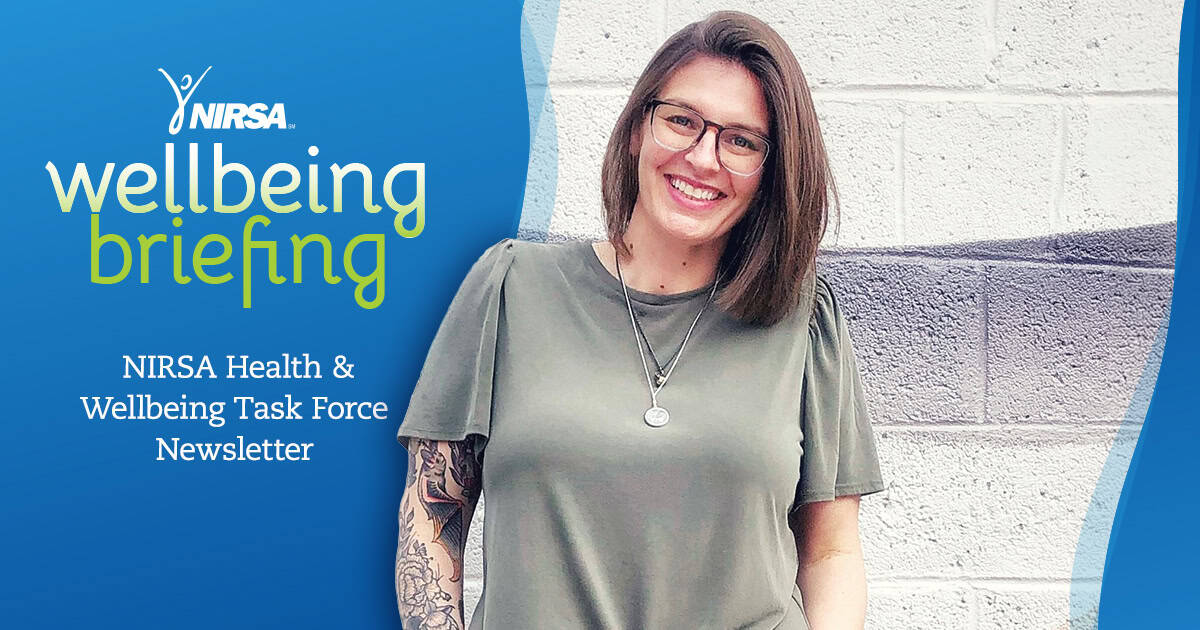
As part of the December 2026 issue of the NIRSA Wellbeing Briefing, supported by the NIRSA Foundation, we reached out to Erin Patchett, Director of Administration and Assessment, Recreation Center at Colorado State University for a question-and-answer session about research in campus recreation.
CSU’s department typically employs between 300 and 350 students, depending on the season.
Wellbeing Briefing Work Group: What type of data/assessments do you collect from your student staff?
Erin Patchett: At the unit level, we have a student employee development program (Rec Development Program, aka RDP) and we collect information at the end of each presentation (typically between 8-14 surveys each term). Those surveys include direct measures of student learning (to understand what they learned from the session) as well as Likert-style questions to see how the experience connects to identified Division of Student Affairs’ student learning outcomes.
At the unit level, our Division directs us to perform Student Quality of Work Life surveys every three years, so that is our approach to our climate study for student staff.
At the area level, the various full-time employees (FTE) will sometimes collect data at end of department-wide trainings or in-service trainings; program managers collect a lot of data thru area audits.
Do you collect any data from or perform assessments on the broader student population?
At the unit level, we have a three-year assessment plan; I renew it every three years. Each of our main program and service areas are included in that plan and rotate through a mandate to collect student learning data, program evaluation data, and student success (formerly called diversity) data.
Those efforts are led by area managers, but I coach them to try to turn their attention to participant data, so it often goes to the broader student population. If a program area doesn’t do that, then the chances are, it would instead be focused on student staff and would fall in the above question instead.
We also participate in a divisional beta testing effort to put data into a central location which can be seen in a Power BI dashboard, where we can see impact of student engagement with our department on graduation and retention rates.
Additionally, through program review requirements, we do a large benchmarking survey roughly every five years and it goes to student participants
At the area level, while it’s not part of the departmental assessment plan, I do monitor the number of program evaluation surveys that programmers send out each semester (or at the end of programs). So, program areas are gathering feedback frequently as well, and the survey would go more broadly to student pop.
How do you use the data within Campus Recreation?
Here are some examples of how we use the data that we collect:
- We recently used the data to inform the hours we altered when budget shortfalls happened last year.
- RDP surveys result in changes to what is presented in departmental trainings and how it’s presented (when we do not see the learning we anticipated or planned for); those RDP surveys are also how we collect data on new professional development topics that students might want to see. Responses provide important insights when we recruit presenters for new topics.
- Area managers also track issues with staff and use that data to inform the learning opportunities for their in-service trainings.
- Data also informed the development of our department’s Strategic Plan.
- Demographic data from program areas helps us understand where we are underserving students and informing strategic planning initiatives around program collaborations.
- Data will likely inform additional operational and programmatic changes we may need to make if the budget shortfall projections remain true into budget planning season, which will be starting soon.
What specific assessments are you currently running with the RDP?
We are generally doing student learning outcome assessments. We integrate open ended, direct-measure-style questions to ensure they learn the content. We also use some Likert-style questions (agreement scales) to see how they feel the sessions help them achieve certain outcomes (those are always tied to our divisional learning objectives).
Would you be able to share a few results of a recent survey?
While we no longer facilitate this session, we previously had an inclusion 101 style course and three of the main learning objectives were related to being able to define equity, diversity, and inclusion. In our post-session assessments, it was clear that the student staff who participated in the training were able to define inclusion and diversity but struggled to define equity (our goal was that 80% of attendees would be able to correctly define the terms, and equity always received the lowest correct response rate out of the three words). So, we adjusted two of the training content slides to make sure we not only explained equity better, but that we also demonstrated how it is different from equality. Those changes helped us achieve higher correct response rates for student defining equity.
What specific ways did the data inform the strategic plan?
Our department has recently been participating as a beta tester for our Division of Student Affairs data dashboard project. The demographic data we have access to—for the first time at this scale, scope, speed—allowed us to set a goal in our strategic plan around wanting our student participation numbers to mirror the campus population, which is on track to become a Hispanic serving institution.
About Erin Patchett
Erin Patchett, PhD (she | her) currently serves as Director of Administration and Assessment for Campus Recreation and has 16 years of supervisory experience in higher education. She has a BS in Exercise and an MA in Leisure Studies from the University of Iowa as well as a doctorate in Sport Administration from the University of Northern Colorado. Her dissertation examined equity, diversity, and inclusion in collegiate recreation. Her interests outside of work include reading, playing and watching sports, going to concerts, and drinking coffee.
- For more information about NIRSA member resources, contact NIRSA Staff.