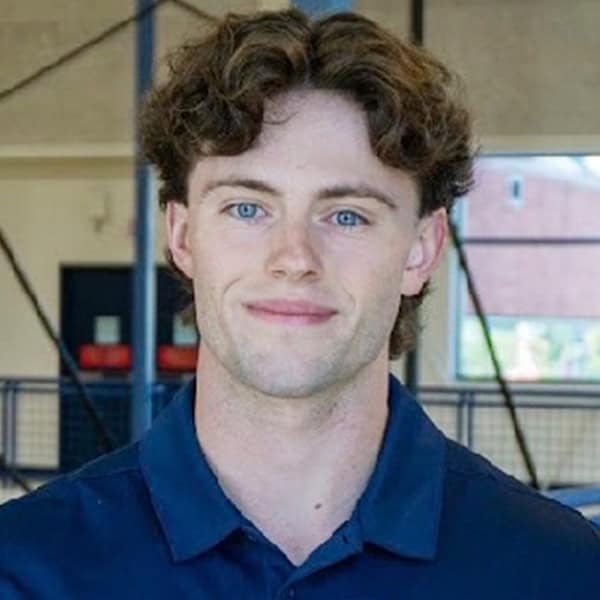

Biography
Keegan Sheffler began his journey in collegiate recreation at Indiana University, where he earned his degree in management. Keegan joined the Intramural Sports Staff as a sophomore and quickly fell in love with officiating and making an impact on other students. This led him to eventually earn a Program Assistant position that allowed him to serve in a larger capacity. He is now pursuing a career in collegiate recreation as a Competitive Sports Graduate Assistant at West Virginia University.
Questions & Responses
Describe your personal perspective on the role of collegiate recreation within higher education. In your response, explain how being involved with collegiate recreation has impacted your own growth and development as a student.
Similar to others in my position, my perspective on the role of collegiate recreation within higher education has continued to evolve since I got my start in Campus Recreation as an Intramural Sports Official. I believe that we serve a very unique, but vital role on a college campus. Collegiate recreation provides students with an outlet that is low-barrier and gives them the opportunity to determine their level of involvement. As we navigate the changes of the world and our country, collegiate recreation is a constant space for students to connect, grow mentally and physically, and lead active, healthy lifestyles. I know this is true because I am speaking from my own experience. Being involved with collegiate recreation has provided me with the opportunity to discover my “why”. As a student that is constantly looking for ways to grow and develop, learning how to be a servant leader and has been at the top of my college “to do” list. My interactions with professional staff, student staff, and participants have helped me grow and develop into the young professional that I aspire to be. There are countless opportunities that I have had to learn and grow not only as a young professional in the field, but as a person and human. At the end of the day, we get to serve students that are looking for this place in the world, just as I was as a freshman at Indiana University, and it is vital that we provide them with a safe and welcoming space to discover who they are.
Share the ways you have been involved with NIRSA (e.g., volunteering, presentations, previous leadership roles, etc.). Explain how these experiences have prepared you to represent and advocate for students in collegiate recreation.
My opportunities to be more involved with NIRSA have increased in my current Graduate Assistant role at West Virginia University, but prior to this year, I had the opportunity to serve as the Logistics Committee Chair for Region III Student Lead On 2025. This was an incredible opportunity to get very involved in conference planning and provided me with experiences that will benefit me in the long run. This role helped me learn how to go the extra mile to make sure all attendees were comfortable and happy. Balancing this alongside ensuring we are able to accommodate each individual student was a tall task for someone with little experience, but I believe this showed me how to truly advocate for my peers at a high level. Riley Feiner was an amazing resource throughout this process and I credit her with a large part of the success of this conference. Working alongside her showed me new ways of thinking and how to be a strong representative for the students attending this conference. Outside of conferences, I have served as a Tournament Experience Committee member for the NIRSA Champ Series National Soccer Tournament. This was a career defining experience for myself. Being able to provide hundreds of club athletes with an incredible environment to play and represent their schools meant a lot to me and my hard work has led me to apply to serve on the National Soccer Work Team. I believe that serving as the Region II Student Leader would allow me to gain further experience in leadership within NIRSA, but also as a leader of my peers. I believe in being a strong advocate and model representative of the collegiate recreation student body that I am grateful to be a part of.
Within the context of the NIRSA Strategic Plan, what area/item would you say is a major issue students face today? How would you address this issue during your term?
Basing my response off of the NIRSA Strategic Framework 2024-2027 (the link in this form brought me to an “Error 404” page), I believe that a growing issue students face today is consistent exposure to professional development opportunities. In my experience, most undergraduate students are not aware of what collegiate recreation is or that it truly is an option for students. The students that are super invested and seek out those opportunities will always end up finding them, so I want to find a way to reach the students who aren’t necessarily looking for them. With today’s students, I have learned that they can be very hesitant to speak up when they are in need of help. What I would like to do as the Region II Student Leader is make genuine connections with each of our Region II State Student Leaders and find ways to get in direct contact with students at each of our member institutions in the region. Sabrina’s newsletters have been super informative and resource heavy, and I would like to add to it by working with State Student Leaders to create virtual spaces to connect and educate students across our region about the power and uniqueness of collegiate recreation. The field is in need of more young professionals that are ready to serve and lead, and I would be grateful for the opportunity to provide the students in our region with this opportunity.
The Student Leadership Team focuses on student development, and Student Member recruitment and retention. What skills, talents, and perspectives would you bring to the Student Leadership Team that would contribute to this focus?
As a member of the Student Leadership Team, I believe I will bring a special perspective that focuses on mentoring students and helping them discover their “why” and how they can make an impact. I think that every team should have a member that is especially talented at making connections with individuals, and I will be able to fill this role. Spreading the word of collegiate recreation and helping students see the impact that they can make on their peers around the country is something that I take very seriously. My experience in Intramural Sports has helped me develop a student development mindset, and I have seen how this translates to situations outside of Intramural Sports. Developing students and helping them understand why they are a valuable contributor is a large reason why I love serving in this field. Being able to reach an even larger number of students than ever before will allow be to welcome more young professionals into the field with open arms.
Describe what role you typically take on a team and how your leadership style will contribute to the Student Leadership Team.
I do not believe that I have a designated role on any team. I believe that I am very versatile in the way that I am able to take on any role within a team that best suits the needs of those we are serving. I have a Ted Lasso type of leadership style that can be best described as coaching and mentor heavy. I like to help others find the best way to achieve their goals by explaining my previous experiences and how I have reached a similar goal. The way that I am able to reach a goal is not going to be the same way that another person reaches a similar goal, so adapting my leadership style to the individual that I am working with is vital. I do this by getting to know the people that I am leading first and then using my best judgment to see what role that I need to take in their development journey to help them achieve their goals. Adapting to the person and not the circumstance is key in these situations. I believe the Student Leadership Team would benefit from having someone on their team with high expectations, big goals, and an adaptable leadership style.
As a member of the Student Leadership Team, you have the opportunity to leave a lasting impact on the field of collegiate recreation. However, we acknowledge and respect that you are a student first. Explain how you maintain a healthy balance between your various responsibilities (student, volunteer, athlete, employee, etc.).
During my first semester as a Competitive Sports Graduate Assistant at WVU, I have been able to navigate a heavy and stressful workload by focusing on organization, planning, and excellent communication. Spending the summer and fall semester with no professional staff in my program area has been exceptionally challenging, but I have been supported by my co-GA and the Program Assistants that I oversee. Keeping our team organized and prioritizing communication is what kept us afloat so far this year, and I plan on bringing these qualities to the Student Leadership Team. After a discussion with the current Region II Student Leader, Sabrina, I do believe that this will be manageable. This topic is a major reason why I have waited so long to submit my application. I wanted to ensure that I would be able to exceed expectations in the role and serve to the best of my ability, and I am highly confident that this is the case. I have strong detail orientation and organization skills that will translate to this role and allow me to be the best Region II Student Leader I can be while also maintaining a healthy balance with my graduate assistantship, graduate school, other NIRSA commitments, and my personal life.