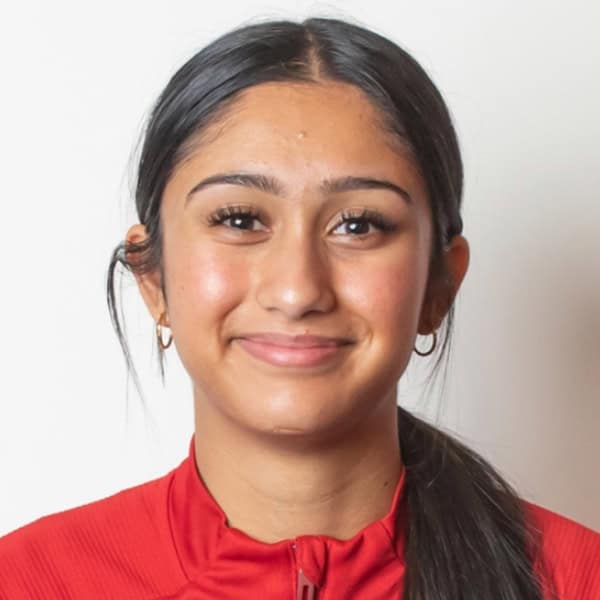

Biography
Simran Lally is a second year university student pursuing a nursing degree. Growing up with a strong background in sport, particularly soccer. Her involvement in NIRSA began at the 2025 Annual Conference in Orlando, where she immersed herself in the experience by attending numerous educational sessions and building meaningful connections with professionals and peers. Inspired by the conference, she is eager to continue her journey in collegiate recreation.
Questions & Responses
Describe your personal perspective on the role of collegiate recreation within higher education. In your response, explain how being involved with collegiate recreation has impacted your own growth and development as a student.
I believe that recreation and wellness are crucial for all people, and this becomes especially true within higher education. College and university students are in a unique stage of life where academic pressures, social transitions, and personal challenges can easily overwhelm their sense of balance. Collegiate recreation provides an essential outlet by offering opportunities not only for physical activity, but also for social connection, and overall well-being. It is a space where students can care for their health, develop lifelong habits, and find community outside the classroom.
My experiences have shown me that recreation is not a “one-size-fits-all” activity. For some, recreation comes through organized sport and competition. For others, it is a way to connect socially, build friendships, or engage in cultural traditions. Still others may see recreation simply as a path to support their mental health or manage stress. Being involved in collegiate recreation has shifted my perspective on these differences and has made me realize that everyone carries a unique relationship with sport and wellness. I believe it is critical that collegiate recreation programs are designed intentionally with inclusion in mind. Every student deserves the right to feel welcome, supported, and encouraged in their pursuit of wellness. For me, recreation is about cultivating an environment where students feel safe to show up as themselves.
Collegiate recreation can be a powerful tool for equity when it works to remove barriers and extend wellness opportunities to everyone. When people think about recreation sport typically comes to mind; however, I think for everyone wellness looks different. An inclusive action plan to promote wellness is creating non sport related opportunities for students to engage in—a paint night would be a good example.
On a personal level, collegiate recreation has had a significant impact on my development. It has strengthened my leadership skills, taught me how to work effectively with diverse groups of people, and deepened my commitment to inclusion and equity. I have come to see wellness not just as a personal responsibility, but as a shared value that should be embedded across higher education.
In many ways, collegiate recreation has shaped the path I am pursuing academically and professionally. It has inspired me to think critically about how sport and wellness can be delivered more inclusively, and it has fuelled my passion for helping others experience the benefits of recreation. I believe that when higher education invests in recreation, it invests in the students and their success—the main goal should be giving all the opportunity to stay well, belong, and thrive
Share the ways you have been involved with NIRSA (e.g., volunteering, presentations, previous leadership roles, etc.). Explain how these experiences have prepared you to represent and advocate for students in collegiate recreation.
In April 2025, I had the privilege of attending the NIRSA Annual Conference in Orlando, Florida, where I connected with professionals and students from a wide range of backgrounds. That experience was eye-opening and helped me gain a deeper appreciation for the impact NIRSA has on student development and campus recreation across North America.Although I have not yet had the chance to directly present or volunteer through NIRSA, I am eager to pursue those opportunities in the coming years. I recognize that leadership is a journey, and I’m excited to continue growing and contributing in meaningful ways as I gain experience. Following the conference, I collaborated with my colleagues to deliver a presentation at my home institution, advocating for more student participation in future NIRSA events. I am also currently serving as the Central Canada Student Leader, a role that allows me to engage with other NIRSA leaders, amplify student voices, and build connections across the region.These experiences have strengthened my passion for student advocacy and my commitment to the NIRSA values. I’m eager to keep learning, contributing, and helping shape a more connected and inclusive student community within the Association.
Within the context of the NIRSA Strategic Plan, what area/item would you say is a major issue students face today? How would you address this issue during your term?
One major issue I believe students face today is a limited or surface-level understanding of what health and well-being truly mean. I think physical activity is often promoted but, the deeper, interconnected aspects of wellness are not always acknowledged or understood. Well-being is holistic, and every dimension—physical, emotional, social, mental, etc—is deeply connected. For example, being physically active does not just improve your health; it can foster stronger social connections, and help build a sense of community/outlets. However, these links are not always made clear, which can lead to students overlooking the full impact wellness can have on their lives.
During my term, I would focus on creating spaces for meaningful conversations around this topic. I would propose wellness roundtables and host both in-person and online seminars that break down what health and wellness really mean, how they differ, and why both matter (done by an expert or someone who is certified to relay this messaging/information). These initiatives would encourage students to view wellness as more than just physical fitness and begin to understand its role in building a unified, supportive campus culture. When students have a deeper understanding of wellness, they are more likely to engage, support one another, and contribute positively to the community.
The Student Leadership Team focuses on student development, and Student Member recruitment and retention. What skills, talents, and perspectives would you bring to the Student Leadership Team that would contribute to this focus?
I am an inclusive leader, and as person of colour, I am deeply committed to advocating for equity, diversity, and inclusion within every space I am part of. I understand the importance of creating environments where all voices feel valued and respected. This perspective drives me to ensure that all students—regardless of background—feel seen, supported, and empowered to get involved. I bring a leadership style rooted in active listening and empathy. I take time to understand different viewpoints and make thoughtful decisions that reflect the needs of the group— I am extremely adaptable. I am also a strong problem solver who approaches challenges and conflicts with calmness and logic. Rather than avoiding confrontation, I aim to resolve it in a way that strengthens relationships and builds mutual respect.
These qualities allow me to support both the development of individuals and the overall cohesion of the team. I believe that strong student leadership requires both advocacy and action, and I’m excited to contribute to a team that prioritizes meaningful engagement, member retention, an inclusive growth.
Describe what role you typically take on a team and how your leadership style will contribute to the Student Leadership Team.
My leadership style is inclusive, versatile, and open-minded. I prioritize creating an environment where everyone, no matter their role, feels welcome to share their ideas and perspectives. I recognize that diverse voices lead to stronger, more innovative outcomes. I understanding that different situations and individuals require flexibility and thoughtful consideration, so I try to be adaptable when appropriate.
I value and prioritize collaboration and discussion, valuing input from all individuals, so that decisions reflect a wide range of experiences and insights. By fostering an open space for dialogue, I help ensure that ideas are challenged constructively and that solutions are well-rounded and creative.
This style can benefit the Student Leadership Team by bringing new and different perspectives into every discussion, strengthening our collective problem-solving and decision-making. By emphasizing inclusivity and versatility, I aim to support a culture where all members feel empowered to contribute, leading to more innovative, thoughtful, and impactful outcomes for the campus community
As a member of the Student Leadership Team, you have the opportunity to leave a lasting impact on the field of collegiate recreation. However, we acknowledge and respect that you are a student first. Explain how you maintain a healthy balance between your various responsibilities (student, volunteer, athlete, employee, etc.).
As a student-athlete, I have grown up learning the importance of balance, time management, and discipline.From an early age, I have actively problem solve how to maintain a busy schedule, balancing academics, athletics, and personal commitments. This experience has shaped my ability to prioritize tasks, stay organized, and remain committed to each of my responsibilities without compromising my well-being.
Being a student-athlete has also influenced my work ethic. The dedication required in sport has carried over into every other part of my life—whether academics, employment, or volunteer leadership. I approach each role with focus, determination, an value each role equally. I strive to make an impact not only in sport but in every area I am passionate about. This perspective allows me to stay motivated even when my schedule is demanding.
To maintain a healthy balance, I rely on strategies such as planning ahead, using organizational tools like calendars, and setting clear priorities. I also understand the importance of communication—being proactive about my commitments ensures I can meet expectations while still supporting my teammates and peers. Just as in athletics, I value consistency and accountability, which helps me manage multiple responsibilities successfully.
These strategies will allow me to contribute meaningfully as a member of the Student Leadership Team.while still prioritizing my role as a student first. By drawing on the discipline and adaptability I have developed as a student-athlete, I am confident in my ability to balance my responsibilities and make a positive, lasting impact within collegiate recreation.