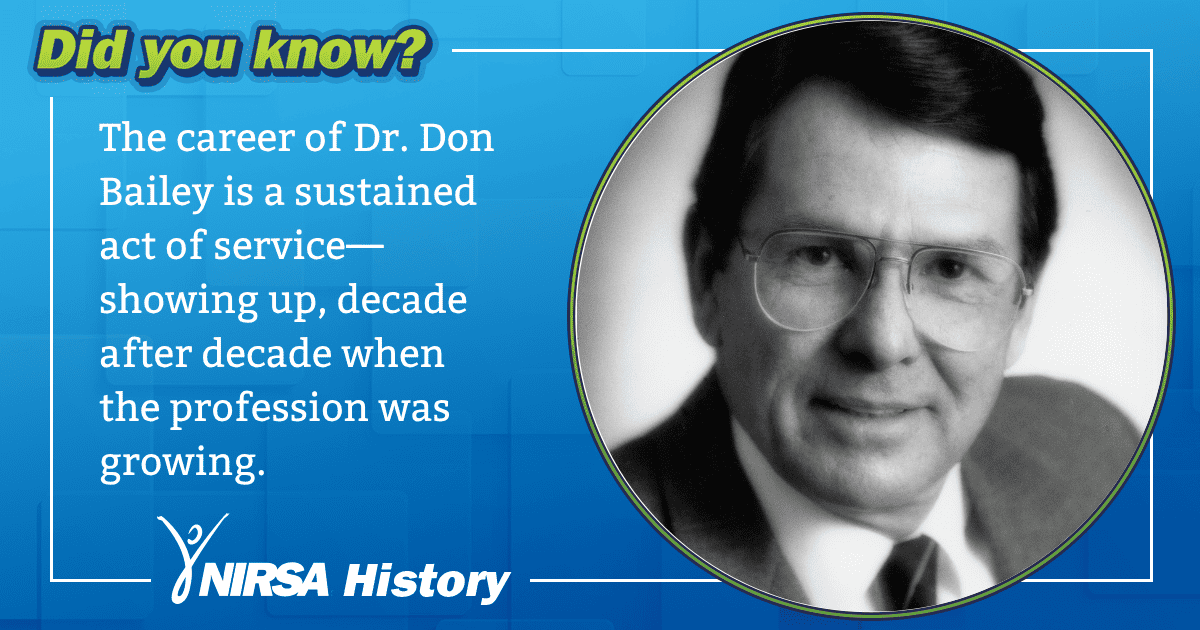
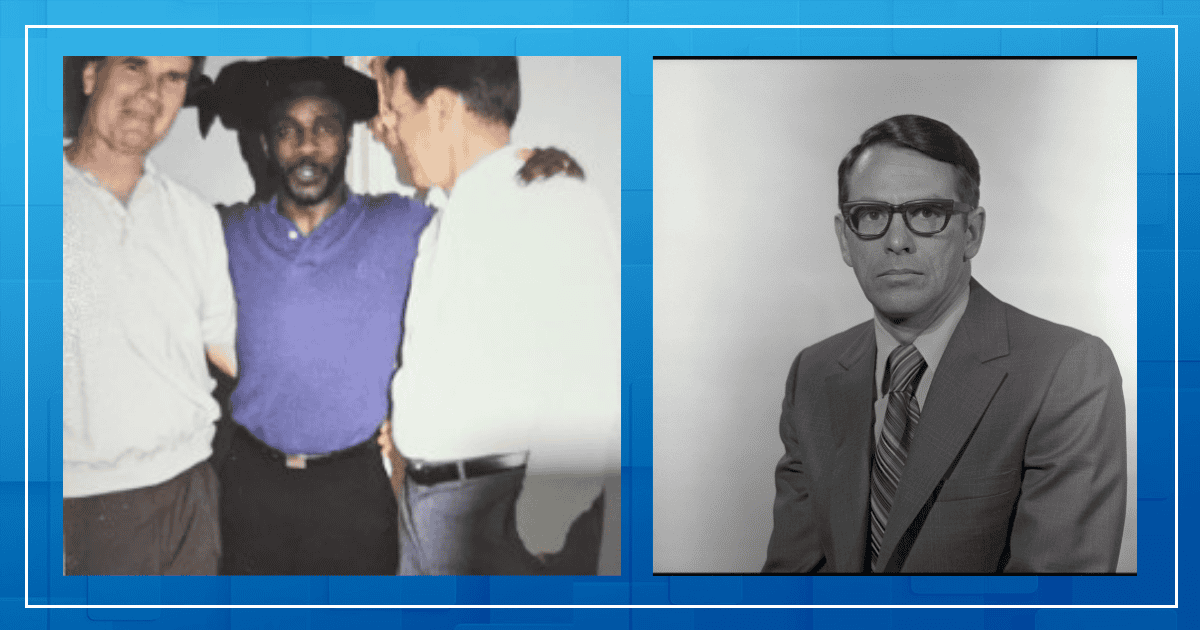
There is a particular kind of person that every profession needs—someone who leads without ego, who writes without vanity, who teaches without keeping score. Dr. Don C. Bailey, retired Director of Intramural Sports at the University of North Texas, is such a person for NIRSA. And the remarkable thing about Don Bailey is not just what he accomplished across his career, but how consistently he chose to give it away.
His story is not a single dramatic moment. It is a sustained act of presence—showing up, decade after decade, in the rooms where the profession was growing, and wisely helping to guide it.
After three years of service in the United States Air Force, Don grounded his career in rigorous study, earning a B.S. and Master of Arts degrees from the University of Iowa and his Ed.D. from the University of Oregon. By the time Don first joined NIRSA in 1964—two decades before he would take on the mantle of President—he’d spent a four-year stint programming intramural sports and coaching at Palo Duro High School in Amarillo, Texas.
Before being elected to serve on the NIRSA Board of Directors, Don had already served on the NIRSA Historical Committee and the Editorial Board for NIRSA Conference Proceedings; he’d also served as Vice-President of NIRSA Region IV as well as a presenter of intramural sports workshops in Europe for the United States Army.
A pivotal year of leadership
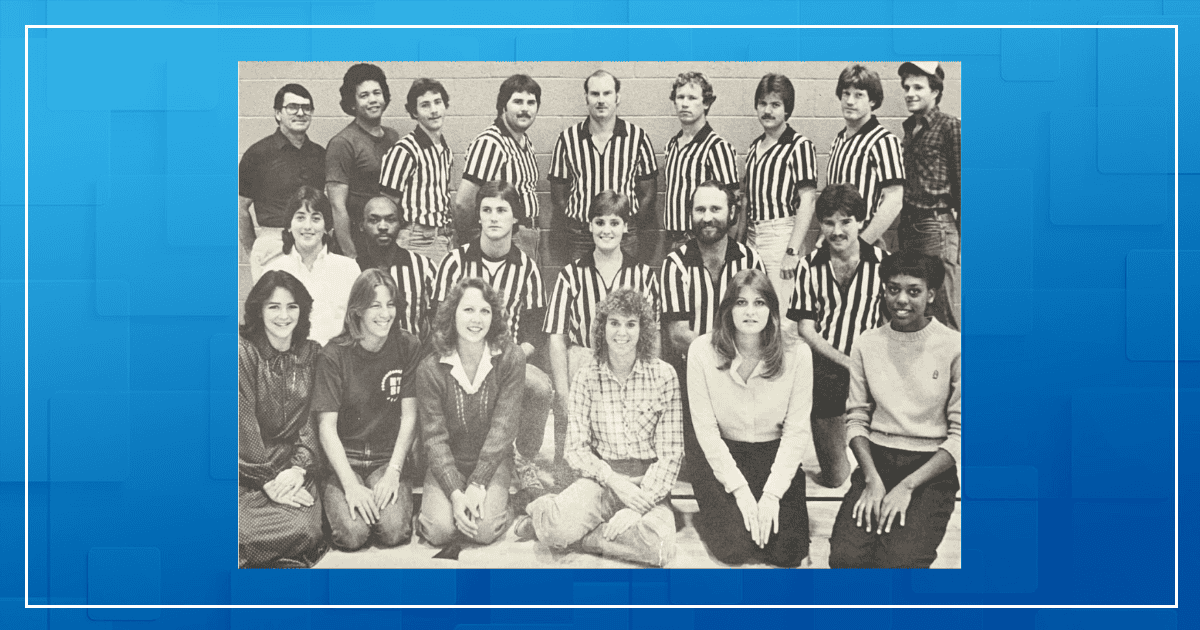
In 1984, Don stepped into the NIRSA presidency at a pivotal moment for the association. Collegiate recreation was no longer content to be an afterthought in higher education—it was pressing its case as an essential part of the student experience, arguing that play was serious, that wellness was academic, that the intramural field and the recreation center had the potential to be as formative as the classroom.
Leading that argument required more than administrative skill. It required someone who understood both the idealism behind the profession and the pragmatic work of building an institution. Don brought both. He was part of a generation of NIRSA leaders who made foundational decisions—about staffing, about governance, about the association’s voice in the broader higher education conversation—that shaped everything that came after, up to the present moment of today.
The professionals who entered the field during and after his presidency often didn’t know, in the immediate sense, how much structural work was being accomplished for their benefit. That is the nature of good institutional leadership: it disappears into the floor you walk on.
Three years behind the desk
From 1987 to 1990, Don served as Editor of the NIRSA Journal—three years that, in retrospect, represent one of the quieter but most consequential chapters of his service to the profession.
Editing a professional journal is unglamorous work. It means reading submissions that need more than they offer, writing rejection letters to colleagues you respect, coaxing revision after revision out of practitioners who are already overcommitted. It means having strong enough opinions to shape a field’s intellectual direction, and enough humility to know that your job is to sharpen other people’s thinking, not to replace it with your own.
Don did this work with care and with conviction. The NIRSA Journal under his editorship was a place where recreational sports professionals could think in public—where a director at a mid-sized university could place their research and their practice into conversation with the field at large. In giving the journal that kind of credibility, Don did something that no president or award committee can do alone: he gave the profession a scholarly memory.
The ‘From the Editor’ notes he wrote across many volumes were themselves small acts of intellectual leadership—framing questions the field needed to ask, acknowledging debates that needed to be had, welcoming new voices while holding the journal to a standard. Those pages, now archived in the Recreational Sports Journal, remain readable today as documents of a profession coming into its own.
The honor that named what everyone already knew
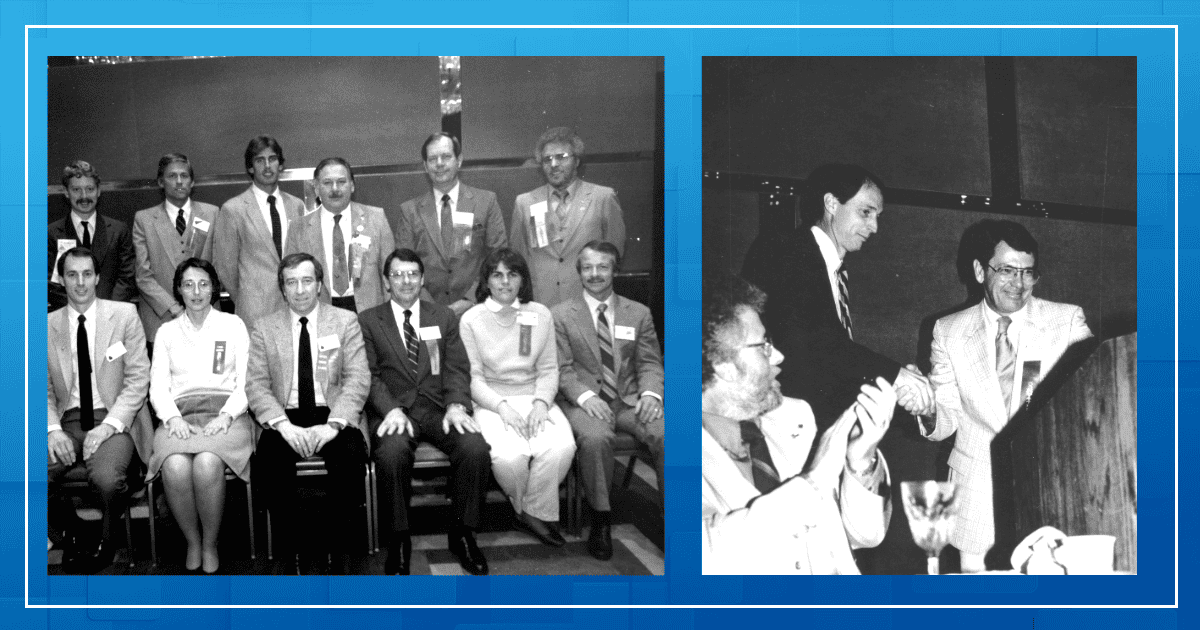
In 1988, the year after he began his editorial tenure, NIRSA presented Dr. Don Bailey with the Honor Award, the highest recognition the association offers. The award is given not for a single achievement but for a life of contribution: to the profession, to the association, to the people who make up both.
It is worth pausing on the timing. Don Bailey received the Honor Award while he was still in the middle of his service as Editor of the NIRSA Journal. He was not being celebrated for a career in its final chapter. He was being recognized in the midst of one—still working, still contributing, still showing up.
That is a particular kind of tribute. It says: we don’t want to wait until you’re done to tell you what you mean to us. We want you to know now, while the work continues.
The University of North Texas, and what it means to stay
For much of his career, Dr. Bailey was grounded at the University of North Texas, where he served in recreational sports leadership and Director—a title that speaks to both distinction and continuity. In a profession where upward mobility often means perpetual relocation, there is something worth honoring about the choice to go deep rather than wide.
What does it mean to stay? It means the students you work with in year three are watching you as professionals in year fifteen, and finding in you a model of what sustained professional commitment looks like. It means the graduate students who pass through your program carry something of your sensibility with them when they take their first director positions. It means that the institution you serve is measurably different—better resourced, better respected, better run—because you were there long enough to see big changes over the line.
The professionals at UNT who worked alongside Don will have their own stories—small moments of mentorship, the offhand remark that reframed a problem, the steady example of someone who took the work seriously without taking himself too seriously. Those stories don’t make it into award citations. But they are the real ledger of a career.
Building what can’t be seen
Every campus recreation program in North America today benefits, in some indirect way, from the work of the people who professionalized this field in the 1970s, ’80s, and ’90s, from those who fought for it to be taken seriously, who built its institutional structures, who gave it a scholarly voice, who trained the trainers.
Dr. Don Bailey is one of those people. The students who find community in a campus recreation center—who discover they are more capable than they thought, who make lifelong friendships over intramural basketball, who return from the wellness center calmer and more focused—are part of his legacy.
A note of gratitude
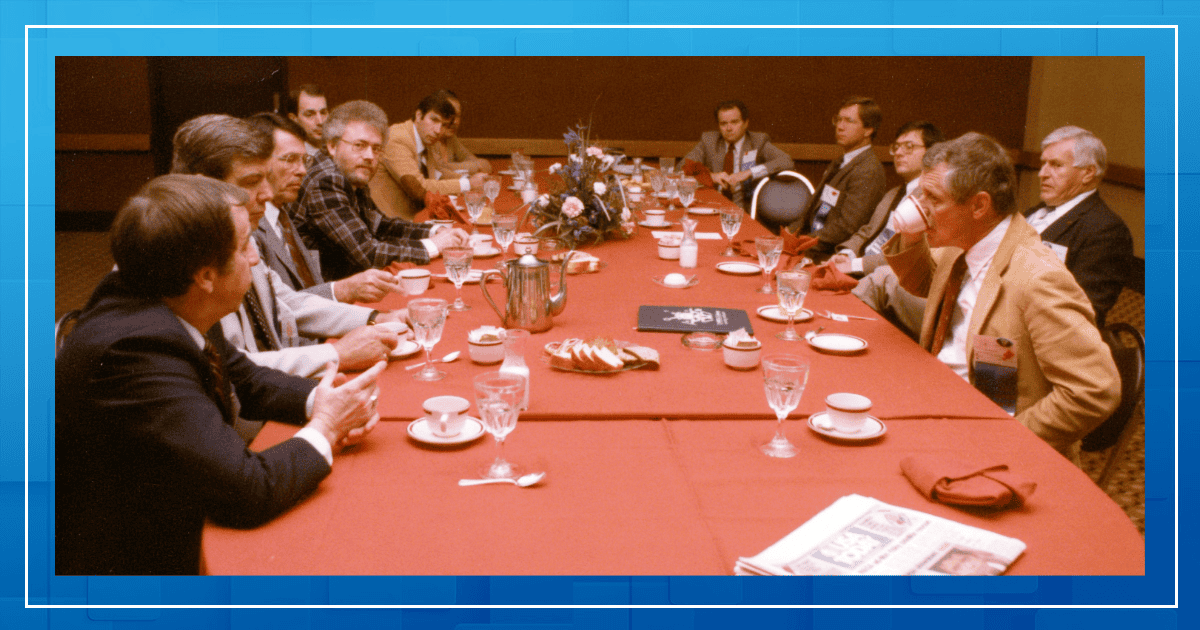
To honor Dr. Don C. Bailey is to see clearly what he did and why it matters: he led when leadership was needed, wrote when writing was necessary, and stayed when staying was the hardest and most valuable thing. NIRSA is better for his leadership and service. The Recreational Sports Journal is richer for his editorship. And the profession carries something of him forward in every program it runs and every student it serves.
Who are the Top 10 humans of your NIRSA history?
The History and Legacy Committee is hoping to amplify diverse perspectives as they work to honor the individuals and milestones that have made a positive impact on your NIRSA experiences.
Take a few minutes this week to list up to 10 individuals, from your perspective, who have had the most significant impact on NIRSA, on the profession of campus recreation, and on your NIRSA experience. Don’t worry about listing them in any particular order.
- If you are interested in highlighting your campus or the achievements of a NIRSA member from your campus, pitch us your ideas.