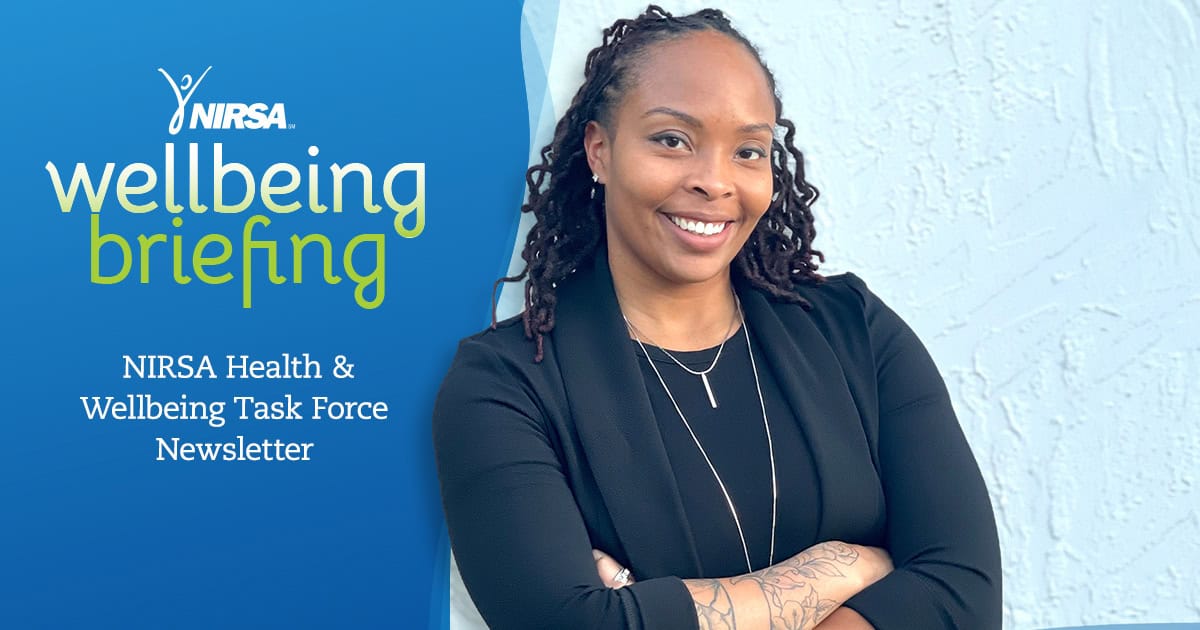
As part of the April 2026 issue of the NIRSA Wellbeing Briefing, supported by the NIRSA Foundation, we reached out to A’Naja Newsome, Lecturer in the Department of Health Sciences at the University of Central Florida for a question and answer session about research in campus recreation.
Wellbeing Briefing Work Group: Why do you think it’s especially important right now to better understand research use in collegiate recreation?
A’Naja Newsome: NIRSA Core Competencies & CAS Standards use evidence-based practices. Governing bodies expect that members use and understand research to inform their daily practices.
In higher education and specifically in campus recreation, resources are limited. Using research allows us to maximize our resources as the reliability we gain from research can be used to ensure best practices for decision making and resource allocation.
From your perspective, what gaps currently exist between research and day-to-day practice in campus recreation?
There are a lot of people collecting data on programs, services, effectiveness, etc. but that data is not widely shared for others to replicate the research. Data dissemination is one of the major hurdles.
Recreation professionals often want to do research, literature reviews, statistical analysis, but aren’t necessarily trained to do these things. The fast-paced environment of collegiate recreation can make it difficult to follow through on conducting research and using the data that is collected. Often, there is not a dedicated research person in a campus recreation department and data sharing is limited on campus (Exercise Is Medicine for example). Administrators may only see an excel sheet on program satisfaction. Larger, long-term research studies facilitated by academic departments can allow us to look deeper on the impact of programs and practices.
If you could change one thing about how research is used in collegiate recreation, what would it be?
Dedicate more funding for college student health and wellbeing preventative research. Provide recognition to researchers and encourage evidence-based practices. Campus recreation helps students learn a variety of coping strategies, resilience, and other skills needed to maintain wellbeing during stressful times.
What systems do you believe campus recreation currently has in place to help facilitate the use of research in practice?
Campus recreation departments have access to a large data set. Most departments have member services software or program software with large populations and segmented demographics. Often, departments don’t have statisticians or researchers on staff, but professionals can partner and provide information or populations for research.
I suggest having a graduate student do a thesis project on campus recreation every year on the impact of campus recreation beyond a participant satisfaction survey. Capitalize on the use of academic partnerships to help facilitate research in your department.
What would you say to departments that don’t currently have academic partners or willing academic partners available?
Look beyond your university and try to partner with colleagues on other campuses where possible. Look through the Recreational Sports Journal and see who is actively working in the research field. Or, see if you can you partner with other departments on campus by providing space, funding, etc. for research to take place. What other incentives can you use to facilitate this – think about all the resources at your disposal.
What else would you like us to know?
For research and evidence-based practice to be important in campus recreation and for professionals to be held accountable for using it, campus recreation and university leadership support is critical.
If you’ll be in National Harbor for the 2026 NIRSA + IDEA® World Conference & Expo, be sure to attend my session: “Evidence-based Practice for Collegiate Recreation Professionals.” It’s happening Thursday, April 9 at 9:05am.
About Dr. Newsome
A’Naja Newsome is an exercise physiologist and has worked in clinical settings to integrate physical activity and exercise in patient care and rehabilitation. Her research focuses on the role that exercise plays in clinical and mental healthcare. Newsome is also interested in the psychosocial aspects of exercise in health promotion such as self-efficacy and motivation. She has more than a decade of leadership experience in collegiate recreation, clinical exercise physiology, and sport performance coaching. She is actively conducting research on the topic.
- For more information about NIRSA member resources, contact NIRSA Staff.