A member with a mission
Paul believes he was destined to work in campus recreation. At sixteen, he started umpiring little league baseball and found he enjoyed officiating. At UC Davis, he and his roommate got involved officiating flag football, which led Paul to become the head of officials for the program and allowed him to interact with the rec staff. He became good friends with the assistant directors Richard Coates and Claudette Dubilewski, and at Claudette’s encouragement applied to the master’s program at Michigan State. “Claudette told me about her experience in the graduate program there and the opportunity for assistantships, and I realized these professional staff were making careers out of campus recreation,” says Paul. “I went from coordinating officials at my undergraduate to looking at it as a legitimate profession.” He discovered further opportunities within the profession through his involvement in NIRSA. When he was in graduate school, the 1976 NIRSA Annual Conference just so happened to be in San Diego, California—Paul’s home state. Since it gave him an excuse to visit home and check out career opportunities, he attended the conference and has been a NIRSA member ever since. His first job was in municipal recreation at Marshall, Michigan, where he says he got five years of experience in the year he was there. He then became Director of Recreational Sports at the State University College at Oneonta in New York, before going to Kent State University. He earned his Ph.D. in Higher Education Administration in 2002 from Kent State, and has gone on to become a faculty member in Sport Management—first at Ashland University and now at Cleveland State University. “I realized early on the value of membership in NIRSA: the comradery as well as the professional contacts and associations,” he says. Paul has been an active member during his 43 years with the Association. His leadership roles include serving on the Career Opportunities Committee and the Research Committee, serving as chair of the Historical Committee and the Region III Award Committee, running several state workshops, teaching at the NIRSA School, getting involved with the Research Institute at Ohio State, and writing and publishing his own research findings.“I realized early on the value of membership in NIRSA: the comradery as well as the professional contacts and associations.”
The empirical movement
When the first NIRSA Journal was published in 1977, NIRSA President Thomas Sattler envisioned it as a “journal of sharing.” Though its articles were peer-reviewed, they were more focused on how-to articles or anecdotal thought pieces rather than verifiable research. “To say recreation is a legitimate profession doesn’t even do it justice, and yet there was a need for reliable data,” explains Paul. “We were handing statistics to the powers that be at the university and they were asking, ‘Where’d you get this? Can you really verify it?’ and we couldn’t. We were estimating and sometimes estimating way high.” Paul was already writing and publishing empirical articles and felt that he could really help get the ball rolling on a more empirically-based body of research. “I’d go to all these conferences and hear people talk about how we’re not making any headway and started thinking that what we really needed was research that we could take to our presidents and vice presidents and say ‘Look at this, if you don’t think we’re having an impact, then look at this.’”“What we really needed was research that we could take to our presidents and vice presidents and say ‘Look at this, if you don’t think we’re having an impact, then look at this.’”
“We’re providing evidence that indicates that campus rec programs do have an impact on retention, recruitment, leadership, time management, and all these things that partner with the academic endeavor.’”
A premier sport-related journal
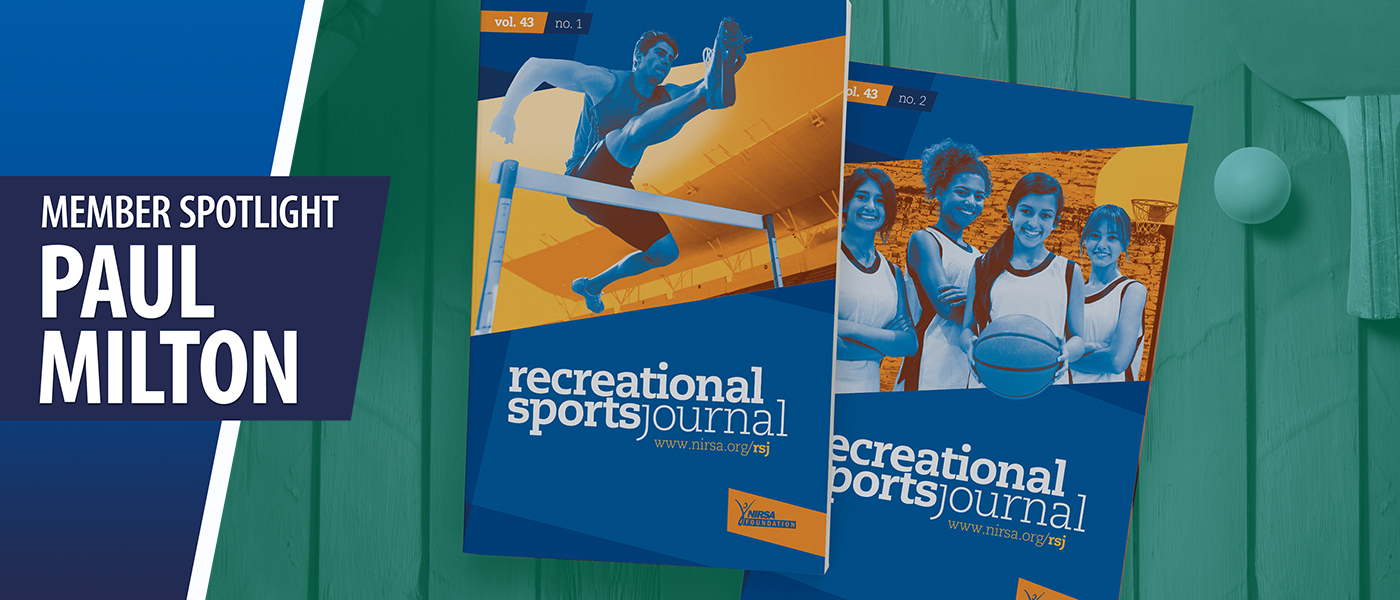
A lot of factors go into making a scholarly journal a premier publication. One is longevity, and the RSJ is one of the oldest sport-related journals. Another factor is the quality of the articles published. The publication rate of the RSJ has decreased over the years, meaning they publish fewer articles, but this has actually caused an increase in quality submissions since editors can be more selective and continue to build the reputation of the journal. A premier publication attracts premier submissions because contributors send their best work to respected high-tier journals. A third factor of premier status is a publication’s h-index, which continues to rise for the RSJ. Paul says that it’s been a goal of his to move the RSJ towards gaining an impact factor since learning about scholarly journal ratings such as the Eigenfactor score and h-index calculations that measure the influence of the articles published in a scholarly journal. “The impact factor is calculated based on a number of different factors including the total number of articles published, the total number of citations, average citations per article, articles per author, citations per year, and how often other authors use the content of the journal for their own research,” explains Paul. The North American Society for Sport Management (NASSM) recently released new ratings, and the RSJ has an h-index of 11, a six-point increase since 2014. According to Paul this suggests that the RSJ is “on the cusp of an impact factor” in the category of school and university sport, a highly-coveted distinction for scholarly journals. “Getting an impact factor really enhances the reputation of a journal,” he says. Looking forward, he says focusing on publishing work by diverse authors, especially international authors, as well as fostering a diverse editorial team will bring further credibility to the RSJ and move it even closer to an impact factor. “I don’t think it’ll happen during my tenure but that’ll be something fun for the next person to come in and say it happened under their watch and maybe they’ll say about me that I’m the one that got it started like I said about Lynn who started the empirical movement,” he says.What’s on the horizon
Paul is excited about what he envisions for the future of the RSJ and the field of campus recreation. For the RSJ, he predicts more specialty issues of the journal, in which a topic will be identified and all the articles published in a particular issue will focus on that topic. “I think it will be a good direction to talk to the members of the Association and see what is of interest to them and then run a topical issue on it,” he says. “You could pick a topic far enough in advance to give people time to get a good empirical study done or write a well-researched thought piece.” He also anticipates that the editorial team will continue to streamline their processes and take full advantage of available online tools for managing submissions. Since the RSJ recently moved from publishing with Human Kinetics to Sage Publishing, he’s excited to see what kind of capabilities will be enabled to help assign associate editors and make it easier to create a specialty journal. In the field as a whole, he sees a continuing trend of campus rec professionals moving into higher levels of leadership within student affairs now that the value of recreation is well understood. “Rec professionals have dealt with large budgets and large staffs and they understand institutional politics as well as anyone,” he says. “They have such a good management background and understanding of how to make things happen inside of an institution.” From a more philosophical position, Paul says people working in campus recreation have been good facilitators and good team players, which translates to a better understanding of how to collaborate with campus partners. “They understand they’re not the only program in existence at the university,” he says. For Paul personally, he plans to keep busy conducting his own research and staying involved with NIRSA. He looks forward to submitting articles to the RSJ again once he is no longer on the editorial team. He has also found plenty to do at Cleveland State University, where he serves as Assistant Professor & Undergraduate Coordinator of Sport Management in the Department of Health and Human Performance. After getting the recreation center at Kent State up and running, he wanted to do something different and has since then found a passion for teaching. He recently rewrote the sports management curriculum at Cleveland State and enrollment increased from 33 to 85 students this year. Paul heaps credit onto his fellow volunteer leaders for making his tenure as Editor-in-Chief so successful: “The dedication and hard work of the RSJ Editorial Board and the support and enthusiasm from the NIRSA Foundation were huge factors in the successes during my tenure,” Paul says. When discussing his transition from recreation professional to full-time faculty, he made the comment that “one person can only do so much and then you’ve got to bring new people in and leave your vision with them.” This seems especially applicable to his long tenure with the RSJ. One person may only be able to do so much, but for Paul, his contribution spans decades. Undoubtedly, he has succeeded in building the scholarly reputation of the RSJ and leaving a strong foundation for the future. Though the time has come for him to leave his vision in the hands of those who come next, we can only look forward to what else will be accomplished.“One person can only do so much and then you’ve got to bring new people in and leave your vision with them.”
Apply to be the next editor-in-chief of the RSJ
Qualified NIRSA members who are interested in serving the profession in the editor-in-chief capacity are encouraged to apply. To view the position requirements, please download the application instructions available on the RSJ webpage of the NIRSA website. For full consideration, please submit all application materials on or before Friday, January 11.About NIRSA and the RSJ
NIRSA is the professional association for recreation and wellbeing on college campuses. Through the platform of inclusive recreation, members impact more than 10 million students each year, helping them develop healthy habits for life. The association supports members with credible evidence of the impact of campus recreation on student recruitment, retention, health and wellbeing, as well as student learning outcomes and post-graduation employment success. The NIRSA Foundation is the philanthropic arm of NIRSA and provides opportunities for NIRSA members and corporate partners to invest in the profession. The Recreational Sports Journal is the NIRSA Foundation’s scholarly publication for sharing empirical, theoretical, and applied research in the field of campus recreation. Donations to the NIRSA Foundation support scholarships, student officials’ development, leadership opportunities, and research.- For more information about the Recreational Sports Journal, contact NIRSA Research Coordinator Ruben Guzman.
- If you are interested in highlighting your campus or a NIRSA member’s achievements on your campus, pitch us your ideas.